
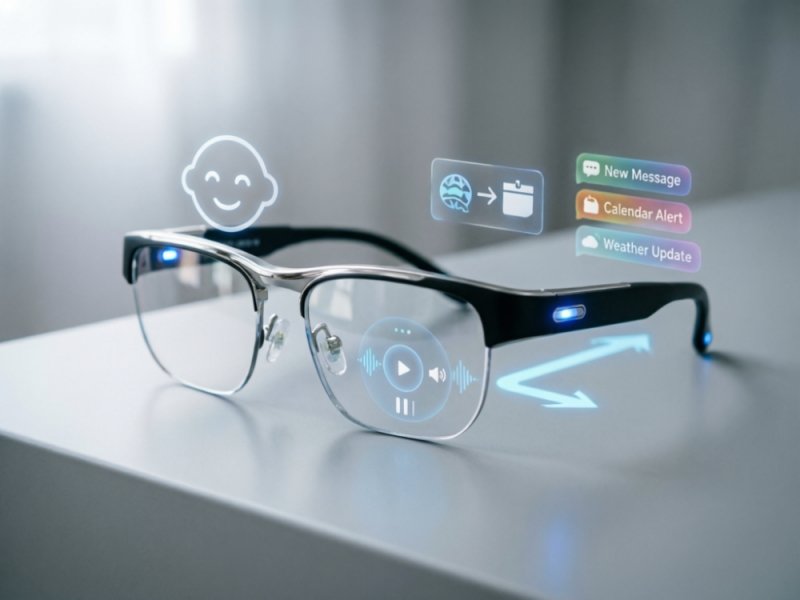
AI smart glasses are rapidly becoming one of the most exciting categories in wearable technology. They combine the convenience of traditional eyewear with intelligent software, hands-free controls, connected features, and in some cases cameras, voice assistants, audio playback, translation tools, and real-time contextual support. As the market continues to evolve, more consumers, brands, and technology buyers are asking the same questions: what are AI smart glasses, how do they work, what can they actually do, and are they worth buying?
This guide answers those questions in detail. It is designed for consumers researching wearable devices, as well as distributors, retailers, and brand buyers looking for a deeper understanding of this fast-growing product category. We will also explain how AI smart glasses compare with regular smart glasses, where they deliver the most value, and what to consider before choosing a model or developing a private-label product line.
For companies like Royaltenic, which specializes in smart wearable devices and has built strong expertise in smart eyewear technology, AI smart glasses represent a major opportunity. They bring together innovation, style, functionality, and practical daily use in a way that matches the direction of modern consumer electronics.
What are AI smart glasses?
AI smart glasses are wearable glasses that combine traditional eyewear design with digital technology and artificial intelligence features. Unlike standard glasses, they can include microphones, speakers, touch controls, cameras, sensors, wireless connectivity, and software systems that respond to voice commands or user behavior. The “AI” element means the glasses can process information more intelligently, assist with tasks, and provide more personalized or context-aware interactions.
In simple terms, AI smart glasses are designed to help users stay connected and access useful features without constantly looking at a smartphone. Depending on the model, they may support voice assistants, hands-free calling, music playback, translation, reminders, photo or video capture, and interactive information delivery.
Some AI smart glasses also include visual interfaces, such as heads-up displays or augmented overlays, while others focus on audio-first experiences. This means the category is broad. Not all products offer the same level of functionality, but the core concept remains the same: they bring intelligent digital support into an everyday wearable form factor.
Key characteristics of AI smart glasses
Most AI smart glasses are built around several core components:
- Wearable frame design for daily use
- Bluetooth or wireless connectivity for pairing with phones or apps
- Microphones and speakers for voice interaction and audio feedback
- AI-powered software for smart responses and assistance
- Optional cameras or sensors for capturing information from the surrounding environment
- Mobile app integration for setup, settings, updates, and content management
The best AI smart glasses are not only functional but also comfortable and stylish. This is an important factor in adoption. Users want smart eyewear that feels natural to wear throughout the day, not a bulky gadget that only works in limited situations.
Why AI smart glasses matter
AI smart glasses matter because they make digital interaction more seamless. Instead of pulling out a phone to check directions, ask a question, record a moment, or answer a call, users can access these functions in a more natural and hands-free way. That makes them especially attractive for commuting, travel, work, fitness, content creation, and multitasking.
As artificial intelligence becomes more capable, AI smart glasses are moving beyond simple connected accessories and becoming intelligent personal assistants that users can wear.
How do AI smart glasses work?
AI smart glasses work by combining hardware, software, and connectivity into one wearable device. The glasses usually include onboard components such as microphones, speakers, batteries, touch panels, cameras, and wireless chips. These components communicate with software running either on the glasses themselves, on a connected smartphone, or in the cloud.
When a user gives a voice command, taps the frame, or activates a feature through an app, the system processes the request and returns a response through audio, visual feedback, or both.
Core technologies behind AI smart glasses
The following technologies usually make AI smart glasses possible:
1. Sensors and input hardware
AI smart glasses use microphones to hear voice commands, buttons or touch-sensitive sides for manual control, and sometimes cameras to capture images or identify objects. Some models may also use motion sensors or proximity sensors to improve interaction.
2. Wireless connectivity
Most AI smart glasses connect to a smartphone via Bluetooth. This allows the glasses to access phone calls, notifications, media playback, navigation data, and app-based services. Some advanced models may use Wi-Fi for faster syncing, cloud access, or firmware updates.
3. AI software processing
The artificial intelligence layer can interpret voice commands, answer questions, translate speech, summarize information, or recognize patterns. Depending on the system architecture, this processing may happen:
- directly on the device,
- through a connected mobile app,
- or through cloud-based AI services.
4. Audio output or visual display
Some AI smart glasses communicate with the user through open-ear speakers, allowing them to hear music, directions, or assistant responses while still remaining aware of their environment. Others may include a small display lens or heads-up projection for visual information.
A simple step-by-step example
Here is a basic example of how AI smart glasses work in everyday use:
| Step | What Happens | User Experience |
|---|---|---|
| 1 | The user wears and pairs the glasses with a smartphone | The glasses connect through Bluetooth |
| 2 | The user says a command or taps the frame | The system activates the assistant |
| 3 | The AI processes the request | This may happen on-device, via app, or in the cloud |
| 4 | The glasses deliver the answer | Through audio, display, or both |
| 5 | The user continues moving hands-free | No need to stop and check the phone |
This hands-free interaction is one of the strongest selling points of AI smart glasses.
The role of companion apps
Many AI smart glasses rely on a companion mobile app. The app can be used to:
- pair the device,
- update firmware,
- change controls,
- manage captured content,
- view battery status,
- customize voice settings,
- and integrate with other services.
For manufacturers and OEM/ODM partners, app integration is also a major part of product value. A good hardware product needs a smooth software experience to support long-term user satisfaction.
What can AI smart glasses do?
The value of AI smart glasses depends on what they can do in real-life situations. While features vary by product, the category is becoming increasingly versatile. AI smart glasses are no longer just experimental gadgets. They are evolving into practical devices that support communication, entertainment, productivity, and convenience.
1. Hands-free communication
Many AI smart glasses support:
- answering phone calls,
- making voice-based calls,
- listening to messages,
- using voice assistants,
- and receiving notifications.
This is useful for people who are walking, driving, working, cycling, or multitasking and do not want to hold a phone all the time.
2. Audio playback and voice interaction
A common feature in AI smart glasses is open-ear audio. Users can:
- listen to music,
- hear turn-by-turn directions,
- access podcasts,
- ask questions,
- and receive spoken answers.
This creates a more natural interaction style than switching constantly between earbuds, phone screens, and wearable devices.
3. Photo and video capture
Some AI smart glasses include cameras that allow users to:
- capture photos,
- record short videos,
- create hands-free first-person content,
- and document experiences in real time.
This is especially useful for travel, outdoor activities, vlogging, commuting, and work situations where using a handheld camera is inconvenient.
4. Real-time information access
AI smart glasses can help users quickly access information such as:
- weather updates,
- reminders,
- calendar events,
- message previews,
- news summaries,
- nearby locations,
- and navigation support.
Instead of interrupting a task to check a phone, the user can stay focused and receive information more smoothly.
5. AI assistance and smart recommendations
The “AI” part becomes more meaningful when the device can provide contextual help. Depending on the product ecosystem, AI smart glasses may:
- answer natural language questions,
- summarize content,
- offer route suggestions,
- support task management,
- provide recommendations,
- or assist with search and planning.
As AI models improve, this category will likely become much more useful in everyday scenarios.
6. Language translation and accessibility features
Some AI smart glasses are positioned for travel or business communication. These may offer:
- basic language translation,
- spoken interpretation,
- text reading support,
- and accessibility assistance.
This opens strong market opportunities for international users, travelers, and professionals working across languages.
7. Entertainment and lifestyle use
AI smart glasses are also attractive as lifestyle products. They can support:
- media listening,
- social content creation,
- interactive experiences,
- gaming extensions,
- and fashion-forward wearable technology.
For a company like Royaltenic, which operates across smart wearables, gaming electronics, and audio products, this multi-category overlap is important. It allows the company to align design, audio performance, smart controls, and product innovation within a connected ecosystem.
Real-world use cases
| Use Case | How AI Smart Glasses Help |
|---|---|
| Commuting | Hands-free calls, music, and navigation |
| Travel | Translation, directions, quick information access |
| Work | Notifications, communication, productivity support |
| Outdoor sports | Audio guidance and hands-free control |
| Content creation | First-person recording and instant capture |
| Everyday life | Voice assistance and reduced phone dependence |
What AI smart glasses cannot do perfectly yet
It is also important to be realistic. AI smart glasses are improving, but they still have some limitations:
- battery life may be limited,
- camera quality may not replace a premium smartphone,
- voice recognition can vary by environment,
- some functions depend on internet access,
- and advanced AI features may rely on app ecosystems or cloud services.
That said, the category is developing quickly, and for many users the benefits already outweigh the trade-offs.
Are AI smart glasses worth buying?
Whether AI smart glasses are worth buying depends on the user’s needs, expectations, and budget. For some people, they are a highly practical daily device. For others, they are still an emerging technology that may be more appealing as a secondary gadget.
When AI smart glasses are worth buying
AI smart glasses are often worth buying if the user values:
- hands-free convenience,
- fast access to communication,
- wearable audio,
- travel-friendly features,
- smart productivity support,
- or early adoption of new technology.
They can be especially valuable for people who are frequently on the move. If someone commutes daily, works in dynamic environments, or wants easier access to calls, messages, and information, AI smart glasses can reduce friction in everyday routines.
When they may be less suitable
They may be less suitable for users who:
- expect full AR experiences from every model,
- want all-day battery life under heavy use,
- prefer traditional eyewear only,
- or do not see value in voice-based interfaces.
Some buyers also assume every AI smart glasses product includes a display, advanced camera, and powerful assistant features. In reality, the market includes many tiers of devices. Understanding the product category before buying is essential.
Cost versus value
To evaluate whether AI smart glasses are worth buying, users should compare:
- price,
- build quality,
- comfort,
- battery life,
- software experience,
- feature set,
- and real daily usefulness.
Here is a simplified decision framework:
| Buyer Type | Are AI Smart Glasses Worth It? | Why |
|---|---|---|
| Tech enthusiasts | Yes, often | Strong interest in new wearable experiences |
| Travelers | Yes | Useful for navigation, translation, and hands-free use |
| Professionals | Often | Helpful for communication and efficiency |
| Casual users | Maybe | Depends on how often they use smart features |
| Budget-focused buyers | Sometimes | Value depends on feature quality and price balance |
Long-term value for brands and retailers
From a B2B and SEO perspective, this question also matters for distributors, e-commerce sellers, and brand owners. AI smart glasses are worth investing in as a product category because they fit several strong trends:
- wearable technology growth,
- AI consumer adoption,
- demand for hands-free devices,
- interest in smart fashion,
- and convergence between audio, camera, and assistant functions.
For private-label and OEM/ODM development, this category offers room for differentiation through design, feature combinations, app integration, packaging, and audience targeting.
Royaltenic’s strength in smart eyewear technology, global export experience, and OEM/ODM service capability makes it well positioned to support brands entering or expanding in this market.
What is the difference between AI smart glasses and regular smart glasses?
The difference between AI smart glasses and regular smart glasses comes down to intelligence, responsiveness, and functionality depth.
Regular smart glasses
Regular smart glasses usually focus on connected hardware features such as:
- Bluetooth calling,
- music playback,
- touch controls,
- voice assistant access,
- camera use,
- or simple notifications.
They are “smart” because they connect to digital systems and offer more than ordinary eyewear. However, many regular smart glasses operate mainly as connected accessories rather than intelligent assistants.
AI smart glasses
AI smart glasses go a step further by introducing software intelligence. They are designed not only to connect, but also to interpret, respond, assist, and adapt. AI capabilities may include:
- natural language interaction,
- contextual responses,
- real-time translation,
- smart search,
- scene or object recognition,
- task support,
- and personalized assistance.
Side-by-side comparison
| Feature | Regular Smart Glasses | AI Smart Glasses |
|---|---|---|
| Audio playback | Yes | Yes |
| Bluetooth calling | Yes | Yes |
| Voice assistant access | Basic | More advanced or integrated |
| AI question answering | Limited | Core feature |
| Context awareness | Minimal | Higher potential |
| Translation support | Rare or basic | More common |
| Smart recommendations | Limited | More likely |
| Productivity support | Basic | Stronger potential |
| User interaction style | Device control | Intelligent assistance |
Why this difference matters
This distinction matters for both consumers and product developers. A regular smart glasses product may succeed on design, comfort, audio quality, and ease of use. An AI smart glasses product must also deliver value through software, interaction quality, and user relevance.
For SEO content, it is useful to explain this clearly because many users search for “AI smart glasses” when they really want to understand whether the product does more than play music or answer calls.
Key features to look for in AI smart glasses
If you are comparing models or planning content around purchase intent, these are the most important features to evaluate:
Comfort and frame design
Smart glasses must be wearable for long periods. Lightweight design, balanced weight distribution, and stylish appearance are critical.
Audio quality
For models with open-ear speakers, clear sound and privacy balance matter.
Microphone performance
Voice interaction depends heavily on microphone pickup and noise reduction.
Battery life
A strong product should offer enough battery for realistic daily use patterns.
App ecosystem
A stable app improves setup, customization, updates, and user retention.
AI usefulness
The most important question is not whether a product claims AI, but whether the AI features are truly helpful.
Camera and privacy controls
If the product includes a camera, users care about quality, indicator lights, content management, and privacy expectations.
How Royaltenic supports the future of AI smart glasses
Royaltenic has built its reputation around innovation in smart wearable devices, gaming electronics, and audio products. Within that broader product portfolio, smart eyewear stands out as a core strength. This is particularly relevant in the growing AI smart glasses market, where successful products must combine industrial design, practical functionality, software integration, and reliable manufacturing.
Founded in 2017 and headquartered in Shenzhen, Guangdong, Royaltenic benefits from a strong technology supply chain environment and export-oriented business foundation. The company’s experience in research, development, production, and sales allows it to support both end-user products and OEM/ODM projects for global partners.
Why this matters for buyers and brand partners
For consumers, it means access to smart eyewear solutions built around usability, style, and technology integration.
For brand clients, it means a partner that can support:
- product customization,
- private label development,
- packaging solutions,
- feature-focused product planning,
- and scalable manufacturing.
As AI smart glasses continue to evolve, manufacturers that understand both hardware and market demands will play a central role in shaping the category.
FAQ about AI smart glasses
Are AI smart glasses the same as AR glasses?
No. AI smart glasses and AR glasses are related but not identical. AI smart glasses focus on intelligent assistance and connected features, while AR glasses usually emphasize visual overlays and digital content displayed in the user’s field of view.
Do AI smart glasses need a phone?
Many AI smart glasses work best when paired with a smartphone because the phone provides connectivity, app integration, and access to cloud-based services. Some features may work independently, but full functionality often depends on a phone connection.
Can AI smart glasses record video?
Some models can, but not all. Camera-enabled AI smart glasses may capture photos and videos, while audio-focused models may not include a camera at all.
Are AI smart glasses good for everyday use?
Yes, many AI smart glasses are designed specifically for everyday use. They can support calls, music, voice assistance, and convenience features without requiring users to constantly check their phones.
Are AI smart glasses expensive?
Prices vary widely depending on design, materials, AI capability, app ecosystem, camera features, and brand positioning. Entry-level products may focus on core smart functions, while premium models offer broader AI experiences.
Who should buy AI smart glasses?
AI smart glasses are ideal for tech enthusiasts, commuters, travelers, professionals, content creators, and users who want a more hands-free digital lifestyle.
Final thoughts: are AI smart glasses the future of wearable technology?
AI smart glasses are becoming one of the most promising categories in consumer electronics because they sit at the intersection of convenience, intelligence, style, and mobility. They offer a wearable interface that feels more natural than many traditional devices. Instead of forcing users to stop and look down at a screen, they support faster, lighter, and more seamless interaction.
The category is still evolving, but the direction is clear. AI smart glasses are moving beyond novelty and toward practical daily usefulness. As hardware improves and artificial intelligence becomes more capable, these devices will likely play a bigger role in communication, navigation, entertainment, productivity, and smart lifestyle experiences.
For users, the question is no longer whether AI smart glasses are real, but which type best fits their needs.
For brands and sellers, the opportunity is even bigger: this is a growing product space with strong SEO potential, consumer curiosity, and room for product differentiation.
CTA: Explore Royaltenic AI Smart Glasses Solutions
If you are looking for innovative AI smart glasses or want to develop your own smart eyewear line, Royaltenic is ready to support your goals. With expertise in smart wearable technology, strong smart glasses development capability, professional OEM/ODM services, and global market experience, Royaltenic helps brands and buyers bring advanced wearable products to market with confidence.
Whether you are sourcing next-generation smart glasses, building a private-label product range, or exploring new opportunities in wearable technology, Royaltenic can provide reliable product solutions, stylish designs, and professional manufacturing support. Contact Royaltenic today to learn more about our smart eyewear capabilities and discover how AI smart glasses can create value for your business and customers.